Table of contents
- Key Takeaways:
- The Role of Educational Manipulatives
- Curriculum-Aligned Product Design
- Existing and Custom Components
- Materials and Tooling
- Product Safety and Testing
- One Kit, Many Suppliers
- Scaling At-Home Learning When Demand Surged
- Qualified Supplier Options
- Tariffs and Total Landed Cost
- State Delivery Requirements
- Classroom Kit Fulfillment
- From Concept to Classroom
Key Takeaways:
- Educational manipulatives connect physical activity with the concepts students are learning.
- Product specifications should reflect the lesson, intended age group, and classroom environment.
- Early decisions about suppliers, testing, and tariffs protect the budget and production schedule.
- Manufacturing is complete only when every component has been packed correctly and delivered to the classroom.
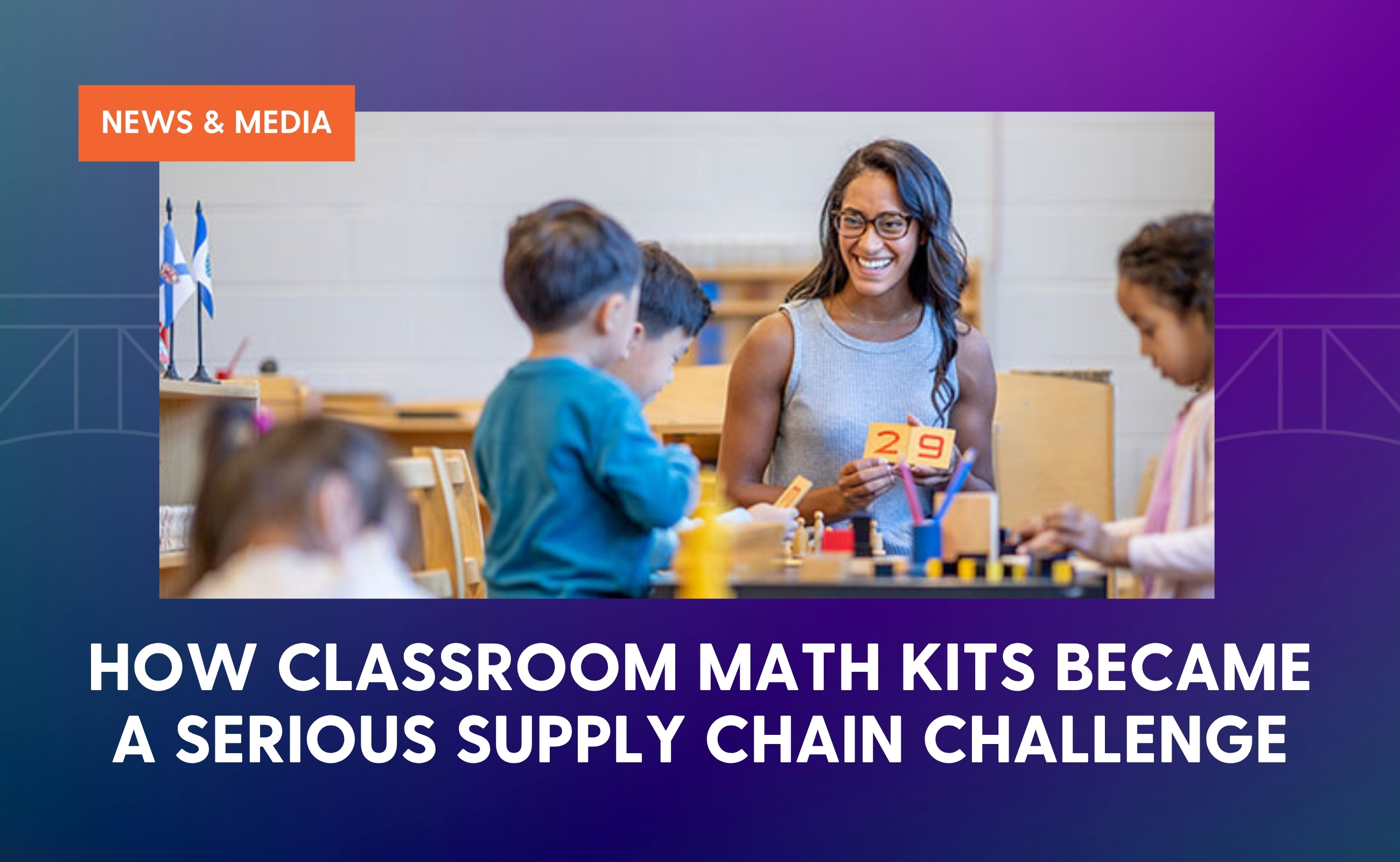
Educational manipulatives are physical tools that students move, arrange, measure, or combine as they work through a lesson. Fraction tiles make numerical relationships visible. Letter tiles let students test spelling patterns, while models and measuring tools give science concepts a physical form.
For educational publishers, developing those materials involves decisions about design, safety, manufacturing, packaging, and delivery. Each component has to represent the lesson accurately, withstand classroom use, meet applicable product safety requirements, and arrive in the correct quantity.
Problems anywhere in the process eventually reach the classroom. A piece with the wrong dimensions can misrepresent a concept, while one delayed component can prevent a complete kit from shipping.
The Role of Educational Manipulatives
Instructional value comes from the way an object supports the lesson. Color can show a relationship between quantities, shape can reveal a pattern, and movement gives students a way to test an idea.
The Institute of Education Sciences recommends well-chosen concrete and semi-concrete representations that connect physical experiences with abstract mathematical concepts. Students need to understand what the object represents, not simply interact with it.
Math programs often use fraction tiles, base-ten blocks, counters, geometric solids, number lines, and measuring tools. Literacy and science programs may include letter tiles, sequencing pieces, models, specimens, and other physical learning aids.
Curriculum-Aligned Product Design
A set of fraction tiles can only represent equivalence if its dimensions are accurate. Letter tiles need clear type and consistent spacing, while geometric pieces must be easy for students to rotate, combine, and compare.
The intended grade level also shapes the design. Products for younger students need to account for hand size, readability, and small-parts requirements.
Teachers have practical needs as well. They have to distribute the materials, identify missing pieces, and return each component to the correct place. Packaging and organization influence how easily the materials fit into daily instruction.
Prototypes allow curriculum teams and educators to handle the product before production begins. A physical sample can expose unclear colors, awkward dimensions, weak materials, or storage problems that aren’t obvious in a digital rendering.
Existing and Custom Components
Some programs can use an existing component that already fits the curriculum. Off-the-shelf products usually reduce tooling time and upfront expense when their dimensions, materials, and function match the lesson.
Custom manipulatives offer tighter control when a lesson requires a specific shape, color, scale, or material. The publisher gains a product built around the curriculum, but tooling and testing add time to the schedule.
The lesson and anticipated volume should guide the choice. A custom product may justify the added development when it plays a central role in the program or will be produced across a large adoption.
Materials and Tooling
Molded plastic, wood, fabric, printed cards, and metal pieces each require different equipment and quality controls. The production team has to reproduce the approved design consistently across the full order.
Material choices influence several parts of the program. A heavier component raises freight costs, while an unusual shape may require a larger package. Fragile finishes increase replacement expenses, and pieces that are difficult to count can slow kit assembly.
Custom molds give publishers control over the finished product but add cost and lead time. Existing tooling can shorten the schedule when it meets the curriculum requirements. Continuum has access to hundreds of molds that may be reused or adapted.
Product Safety and Testing
Many regulated children’s products require third-party testing through a laboratory accepted by the U.S. Consumer Product Safety Commission. Applicable requirements depend on the product, materials, intended age group, and expected use.
Changes in resin, coating, ink, or fabric may affect prior testing and certification. Accurate records need to connect each production batch with its materials and test history.
Safety testing should begin early enough to fit within the production schedule. Addressing a failed result after inventory has been produced leaves little time to change a material, update documentation, or protect the delivery date. Continuum uses Intertek for product safety testing and certification.
One Kit, Many Suppliers
A classroom kit may contain plastic, wood, paper, fabric, and metal components from several suppliers. Each supplier works with different order minimums, production schedules, and material constraints.
Printed cards may be ready while a molded component is still being tested. Packaging dimensions may remain open until the final sample is approved. Assembly can’t begin until every item has arrived and passed inspection.
A kit containing 99% of its components still can’t ship. Publishers need visibility across manufacturing, testing, packaging, and assembly so one delayed piece doesn’t become a surprise at the end of the schedule.
Scaling At-Home Learning When Demand Surged
The Math Learning Center faced this supply-chain pressure when demand for at-home learning materials increased during the pandemic. China’s shutdown disrupted production at the same time schools and families needed materials quickly.
Continuum helped diversify production and sourced approximately 1.4 million manipulative components for nearly 900,000 at-home learning kits. Meeting the deadline required established manufacturing relationships, available capacity, purchasing support, and coordination across production and delivery.
Continuum could move quickly because the suppliers had already been evaluated. A new factory still has to prove that it can meet the specifications, testing requirements, volume, and schedule.
Qualified Supplier Options
Supplier qualification takes time, especially for products intended for children. A manufacturer may have available capacity without experience in the required materials or safety standards.
Alternate factories also have to reproduce the same dimensions, colors, and performance as the original source. Moving production to a different country can introduce new materials, shipping routes, and quality concerns.
Continuum has spent over 20 years developing domestic and international manufacturing relationships with established quality, testing, and traceability processes. The network gives publishers options before a delay or material shortage places the program at risk.
Tariffs and Total Landed Cost
Tariffs should be considered while materials and production locations are still being evaluated. Waiting until a supplier submits a final quote can leave publishers with fewer options.
A complete landed-cost review should include:
- Product and tooling costs
- Safety testing and certification
- Freight, duties, and customs brokerage
- Packaging and kit assembly
- Storage and inventory
- Final delivery
Domestic manufacturing may reduce tariff exposure while increasing labor or material costs. International suppliers may offer greater tooling capacity or access to specialized materials. Some programs benefit from a hybrid model that assigns components according to each supplier’s capabilities.
Changing the country of final assembly doesn’t always remove the original exposure. A factory in another market may still purchase raw materials from China, so publishers need visibility into the source of key materials.
State Delivery Requirements
Adoption states such as Texas, California, Florida, and Georgia use structured processes and contracts. Some materials move through state depositories with specific requirements for shipment batching, labels, receiving appointments, and transportation equipment.
Open-market programs often ship directly to districts or schools. Orders may arrive at different points in the year and in smaller quantities, which changes the inventory and fulfillment plan.
Some receiving locations require liftgate trucks or specialized equipment. Missing one of those requirements can delay a completed shipment.
Classroom Kit Fulfillment
Packaging has to support distribution and classroom use. Teacher kits may need trays, labeled bags, or divided compartments, while master cartons must protect the materials through freight and warehouse handling.
Fulfillment teams also need clear instructions for component counts, kit versions, labels, and delivery locations. An assembly or labeling error can place the wrong materials in a classroom even when production was completed correctly.
Production teams need to work backward from the classroom delivery date. Adoption volumes and order timing may change, but the first day of school remains fixed.
From Concept to Classroom
Educational publishers need visibility across curriculum development, product design, manufacturing, packaging, and delivery. Dividing those responsibilities among separate vendors creates additional handoffs and makes production issues harder to track.
Continuum applies its marketing execution experience to educational product programs by coordinating design support, production planning, sourcing, prototypes, manufacturing, packaging, kitting, inventory, and fulfillment.
Education Bridge brings curriculum development, print production, manipulative manufacturing, packaging, and fulfillment into one coordinated program. Publishers retain control of the learning experience while one team manages the physical program through classroom delivery.